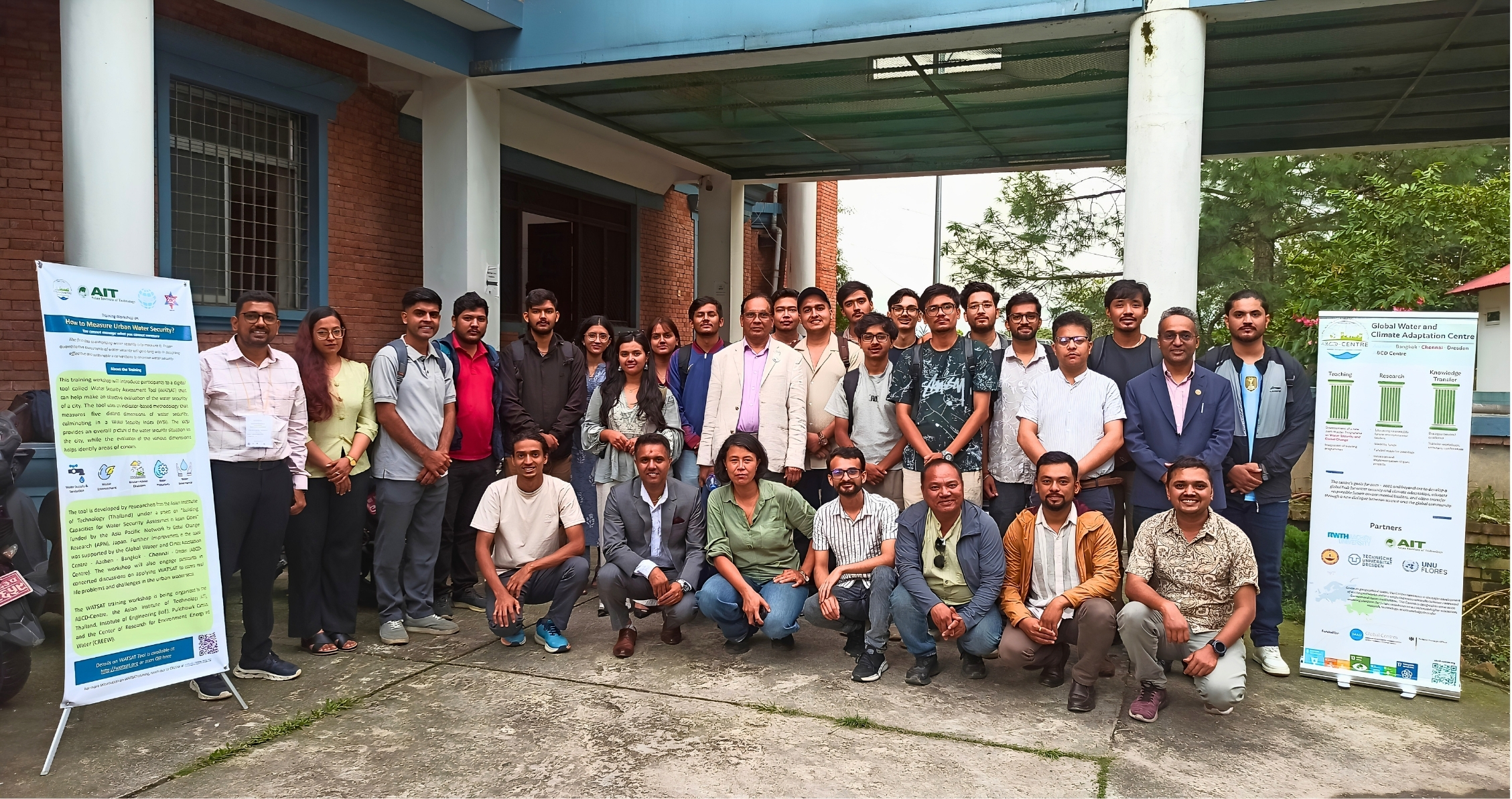
Regional Experts Convene in Nepal to Advance Climate Resilience Through Hands-On WATSAT Training
Kathmandu, Nepal – The Center of Research for Environment Energy and Water (CREEW), in collaboration with the Asian Institute of Technology (AIT), the Global Water and Climate Adaptation Centre (ABCD-Centre, Thailand), and the Institute of Engineering (IoE, Pulchowk Campus, Tribhuvan University), successfully organized a half-day hands-on training workshop titled “Measuring Urban Water Security using the Water Security Assessment Tool (WATSAT)”.
The event was held at the IoE/TU – CES Meeting Hall and brought together 33 participants, including 26 trainees representing local municipal governments, academic institutions, private sector firms, and NGOs. The training aimed to bridge the science-policy-society gap by building local capacity to objectively monitor urban water security in the face of rapid urbanization and climate change.
What is WATSAT?
Water management directly impacts human security, economic stability, and environmental sustainability. While formulating water security policies is critical, tracking the real-world impact of these policies relies on objective measurement. To operationalize the concept following the principle that “we cannot manage what we cannot measure” the Asian Institute of Technology (AIT) developed the Water Security Assessment Tool (WATSAT). Further enhancements to the tool were supported by the ABCD-Centre.
WATSAT is a web-based, indicator-based digital platform designed to help municipal authorities, decision-makers, and researchers evaluate an urban area’s water situation. Built around a flexible, three-layered framework (Dimensions, Indicators, and Variables), WATSAT measures five core dimensions:
- Water Supply & Sanitation
- Water Productivity
- Water-Related Disasters
- Water Environment
- Water Governance
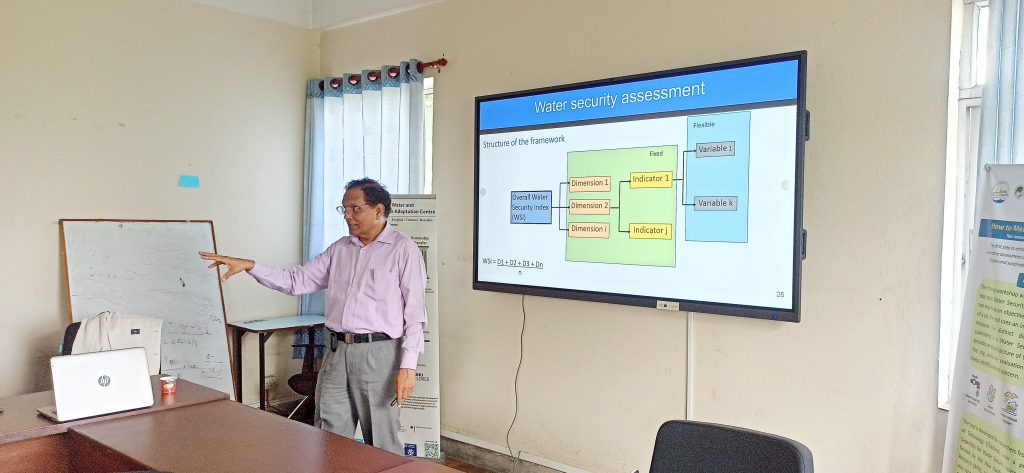
These five dimensions culminate in a single Water Security Index (WSI) scored on a scale from 1 to 5. While the WSI gives decision-makers a high-level picture of overall urban water security, evaluating individual dimensions helps highlight specific local vulnerabilities and guides targeted policy interventions.
Key Event Highlights
The workshop combined context-setting, technical science, and step-by-step practical application:
- Water Security Framework: Prof. Mukand S. Babel (AIT) detailed the core principles of urban water security and introduced the overall assessment framework.
- The Science Behind WATSAT: Dr. Victor Shinde explained the indicator methodology and data structures used to calculate the Water Security Index.
- Hands-on Application: Dr. Triambak Baghel guided trainees through interactive exercises, including web portal registration, data entry, reference value normalization, and running sample evaluations.
- Nepal Context Discussion: Prof. Mukand S. Babel and Prof. Vishnu Pandey (IoE) facilitated a dedicated session on applying WATSAT to resolve water security challenges in Nepalese cities.
- Master of Ceremonies: Master of Ceremonies duties and opening welcome remarks were delivered by Dr. Anil Aryal (CREEW).
To learn more about the tool or conduct an assessment, visit the official platform at watsat.org.

 G.P.O. Box: 25563