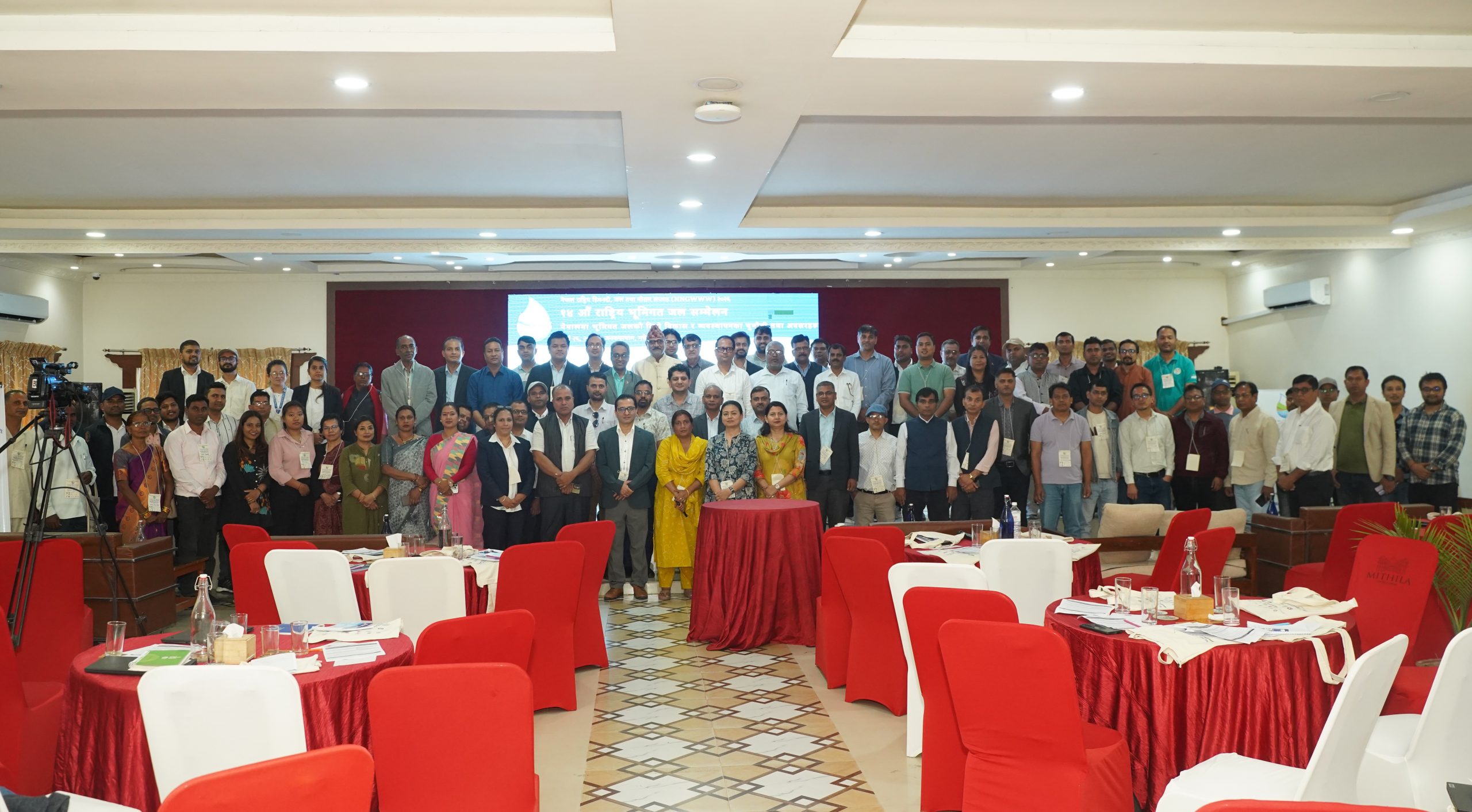
Successful Completion of the 14th National Groundwater Symposium
Fourteenth National Groundwater Symposium draws 151 participants in Janakpurdham; policymakers, scientists, and development partners call for urgent governance reforms as province reels from historic drought
Janakpurdham, 26 March 2026
With tubewells drying up across Madhesh Province and the government declaring a drought disaster for the first time in its history, scientists, policymakers, and development partners converged at Hotel Mithila Yatri Niwas in Janakpurdham on Thursday for the 14th National Groundwater Symposium; the most consequential gathering in the event’s 17-year history.
The one-day symposium, held under the theme “Challenges and Opportunities for Sustainable Development and Management of Groundwater in Nepal,” brought together 151 participants representing federal and provincial governments, municipalities, academia, NGOs, and international organizations. The event was organized under the leadership of the Water and Energy Commission Secretariat (WECS) and the Ministry of Irrigation, Energy and Water Supply (MoEIWS), Madhesh Province, with technical coordination by the Center of Research for Environment, Energy and Water (CREEW).
Opening the symposium, Dr. Dhundi Raj Pathak, President of CREEW, traced the event’s journey from a technical gathering in 2009 to what he described as a “comprehensive, integrated platform” for groundwater governance. Of the more than 1,200 participants who have attended the thirteen previous symposiums, many have returned this year with a heightened sense of urgency. The symposium’s thematic evolution: from purely technical foundations, through governance expansion, to holistic integration, mirrors the deepening crisis it seeks to address.
Er. Sanjeeb Baral, Executive Director of WRERC/WECS, delivered the keynote address, placing Madhesh’s crisis within a global context. He reminded the audience that 2.1 billion people worldwide lack safe drinking water, that four billion face water scarcity for at least one month each year, and that women and girls collectively spend 250 million hours daily collecting water hours lost to education and economic opportunity.
Turning to Madhesh, Er. Baral detailed the causes of the 2025 water crisis: the monsoon of 2082 B.S. brought barely 46 per cent of normal rainfall, wells and boreholes dried up province-wide, and both provincial and federal governments were compelled to declare Madhesh a Drought Disaster Zone; an unprecedented step. “This is not merely a one-year anomaly,” he warned. “It is part of a larger climate change trend that reveals Madhesh’s deep vulnerability to shifting weather patterns.”
Er. Laxmi Pant, Senior Divisional Engineer at MoEIWS Madhesh Province, outlined the government’s proposed response across three pillars: legal and regulatory reform, institutional realignment, and integrated implementation. She called for dedicated provincial groundwater legislation, clear delineation of responsibilities among the three tiers of government, and nature-based solutions including the protection of Chure-Bhabar recharge zones from unchecked mining. Er. Pant also advocated for prioritizing the completion of the long-pending Sunkoshi-Marin Diversion Project, which would irrigate 122,000 hectares across six Madhesh districts. Ms. Arinita Maskey Shrestha, WASH Specialist at UNICEF Nepal, presented a sobering field assessment. In Hansapur, Dhanusha, ninety per cent of community tubewells in all nine wards dried up during the 2023 crisis. She highlighted a litany of systemic failures: fragmented provincial data, limited knowledge among drillers, low community awareness about recharge and water table fluctuations, and a persistent tendency among local governments to manage crises as they unfold rather than prepare for them in advance.
The afternoon technical sessions, chaired by Prof. Krishna Chandra Prasad Sah, brought rigorous academic scrutiny to the province’s groundwater challenges. Prof. Vishnu Prasad Pandey of the Institute of Engineering, Tribhuvan University, offered a candid inventory of knowledge gaps: cross-border groundwater flows remain poorly understood, geospatial maps and technical guidelines for aquifer tapping are largely absent, and no workable action plan for groundwater governance currently exists. “Political will, integrated with community support, a dedicated institution, and an integrated database are the keys to sustainable development,” he concluded. Dr. Bhesh Raj Thapa of Universal Engineering and Science College (UESC), presented evidence on Managed Aquifer Recharge (MAR) as a practical, scalable tool for restoring water security. Dr. Manohara Khadka, Country Representative of the International Water Management Institute (IWMI) Nepal, rounded out the technical presentations with a governance framework encompassing seven dimensions from people-centered policymaking and inclusive community engagement to transboundary water diplomacy with India.
Chief Guest Mr. Jawaharlal Khushwaha, Minister for Irrigation, Energy and Water Supply of Madhesh Province, underscored that nearly 448 water supply projects in the province remain incomplete, many of which could be operationalized with modest additional investment. He stressed the urgency of resolving ownership disputes that have stalled projects and called for their expedited completion. Special Guest Er. Ganesh Shah, former Minister for Environment, Science and Technology, cautioned against the trend of converting ponds and reservoirs into paved surfaces in the name of beautification. He urged planners to restore these waterbodies so that the natural relationship between soil and water can be maintained, a relationship critical to recharge. Hon. Mr. Raj Kumar Singh, Vice-Chairman of the Madhesh Province Policy and Planning Commission, noted that while tubewells once struck water at 100–200 feet, depths of 450–600 feet are now required, a stark indicator of rapid groundwater depletion.
A moderated sector cluster sharing session, facilitated by Er. Kabindra Pudasaini of WaterAid Nepal, gave voice to practitioners rarely heard in formal policy settings. Representatives from Janakpurdham, Lahan, and Birgunj municipalities shared the urban water security challenges their cities face daily. Drilling contractors, the Nepal Water Supply Corporation, agriculture and livestock officials, and community leaders from Mahottari each brought ground-level perspectives on solutions tried, lessons learned, and questions that remain unanswered.
In the closing remarks, Er. Ram Kumar Khang, Acting Secretary of MoEIWS Madhesh Province, struck an unusually concrete note. “We are not just enthusiastic, we are committed to results,” he said, announcing that MoEIWS intends to scale similar dialogues beyond the provincial capital to district and local government levels. For a province where the water table is falling, the monsoon is faltering, and hundreds of water projects sit unfinished, the 14th National Groundwater Symposium may prove a turning point, if the pledges outlast the proceedings.

 G.P.O. Box: 25563