
Virtual e-lightening poster presentation of the tap waters of Kathmandu at AGU 2020, USA
12 December 2020,
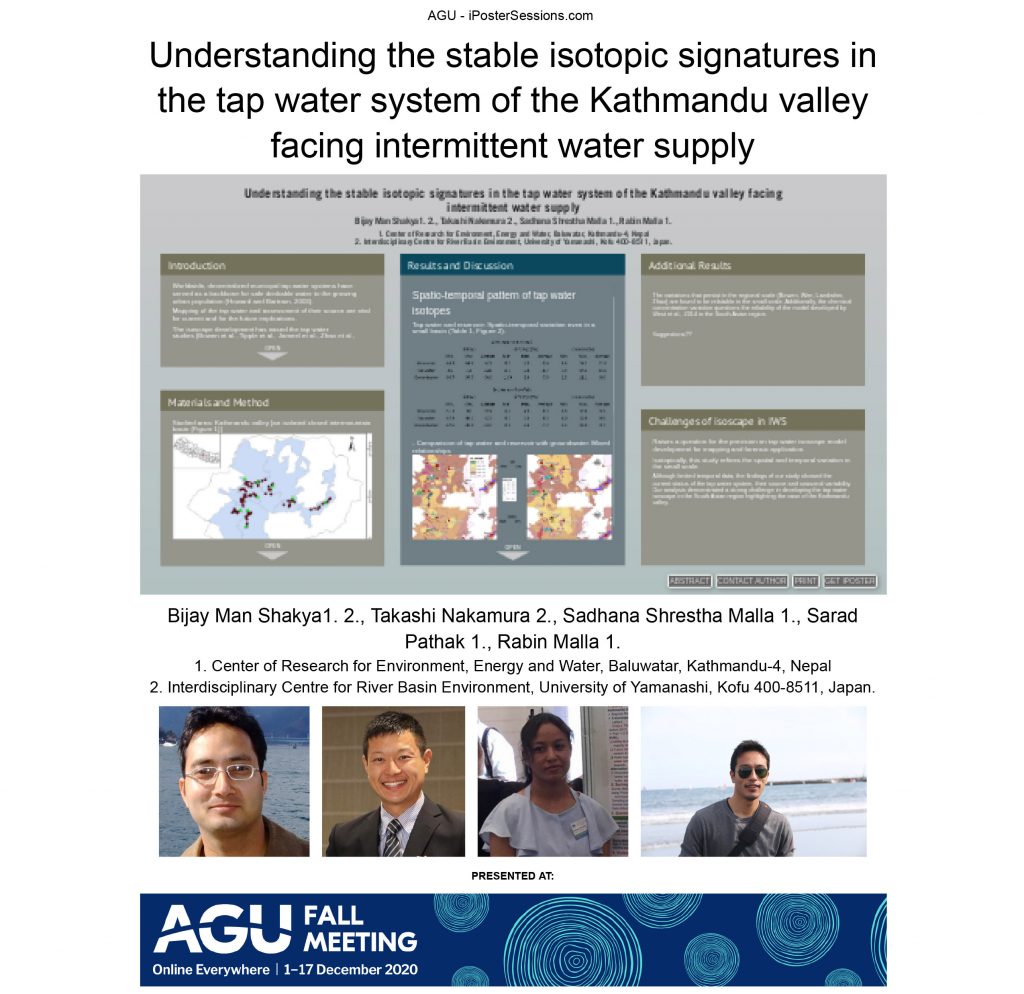
A virtual e-lightening poster entitled ‘Understanding the stable isotopic signatures in the tap water system of the Kathmandu valley facing Intermittent Water Supply (IWS)’ was presented at the AGU Fall Meeting (1-17 December 2020) by Dr. Bijay Man Shakya. The poster was presented on 10 December 2020 under the session ‘Stable isotopes in the critical zone: methods, application and process interpretation (H091)’ chaired by Prof. Dr. Steve Good. The presentation and discussion were both on oral and via. chat messages.
Primarily funded by International Atomic Energy Agency (IAEA) under its Coordinated Research Project (CRP) F33024 – Use of Isotope Techniques for the Evaluation of Water Sources for Domestic Supply in Urban Areas and partly funded by Accelerating Social Implementation for SDGs Achievement (aXis), Japan, the research focuses on the analysis of municipal drinking water system of the Kathmandu valley, Nepal. Prior to the general information on household’s municipal water quality, the study conducted in the year 2019, highlighted tracking the major source of the drinking water and intrusion of the foreign contaminations in the water during the transfer dynamics. Dr. Shakya exhibited the use of stable isotopes of the water (𝛿D and 𝛿18O-H2O) and the chemical concentrations as the tracers. During the presentation, the main result – disparities of the isotopic signatures in both the spatial and seasonal water sources even within the small area was introduced. Related to the diversity, the cause for the variation was suggested as the local management practice and the site-specific contamination which was accepted by the experts too. Although isoscape development is trending, Dr. Shakya also emphasized the challenges and techniques in refining the resolution of isoscape maps for the developing countries and those suffering from IWS. Since, the presented research is the first attempt in the South Asian region, the experts praised the work as unique and suggested to expand further studies in reducing the limitations required for the critically challenging areas.
The presentation is a part of the result from the collaborative research work between CREEW and IAEA and is available on the web browser of AGU 20.

 G.P.O. Box: 25563