Nepal Convenes National Symposium to Confront the Looming “Super El Niño”
Lalitpur, 21 August 2026
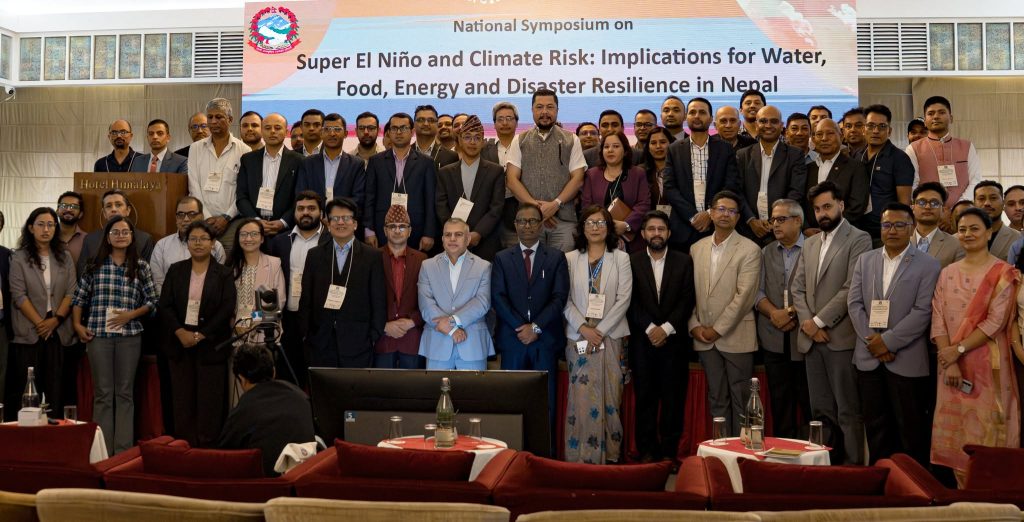
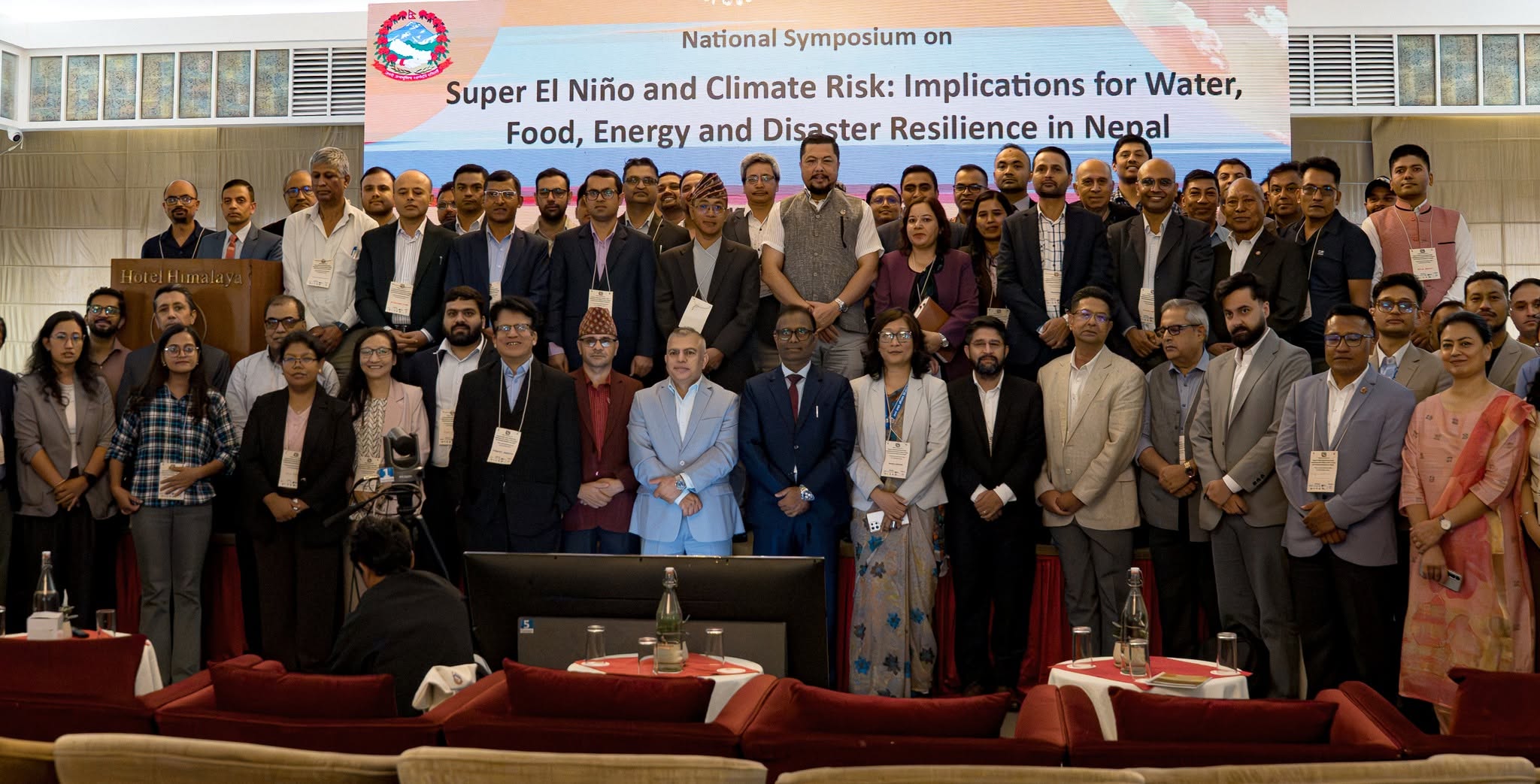
With global forecasters warning of El Niño strengthening by more than 90% chance of being a very strong event during fall and winter 2026-27 in the Northen Hemisphere, the Water and Energy Commission Secretariat (WECS) and the Department of Hydrology and Meteorology (DHM) organized an august gathering of 171 scientists, policymakers and development partners in Kathmandu, Nepal through a National Symposium on Super El Niño and Climate Risk. The gathering was attended by 133 male and 38 women marked the first in a planned series of dialogues aimed at moving Nepal from early warning to evidence-based action.
Held at The Hotel Himalaya and supported by Food and Agricultural Organization (FAO), UNICEF, International Water Management Institute (IWMI), the Local Adaptation to Climate Change (LACC) Project, WWF Nepal, OXFAM and The Small Earth Nepal (SEN), with the Center of Environment Energy and Water (CREEW) serving as secretariat, the symposium’s central ambition was to lay the groundwork for a sectoral actionable Super El Niño Contingency Plan one that translates climate forecasts into practical decisions for Nepal’s water, energy, agriculture and disaster-management sectors.
A Sobering Opening
The inaugural session, chaired by the WECS Secretary Mr. Saraju Kumar Baidya and moderated by Dr. Kapil Gnawali, opened with the national anthem, welcome remarks from Joint Secretary Mr. Tikaram Baral, and a traditional watering-of-the-plant ceremony.
Two keynote addresses set the context of Super El Niño at the global and regional perspective and it’s potential impact to wider sector. Dr. José Álvaro Silva of the World Meteorological Organization (WMO), joining virtually, gave a global overview of El Niño conditions and seasonal outlooks, underscoring the need for localized preparedness. Mr. Dhyey Bhatpuria of IWMI introduced the ENSO Outlook 2026 platform, pointing to a persistent gap between the availability of forecast signals and the lack of pre-arranged, pre-financed action to use them.
Ms. Sarita Dawadi, Secretary of the Ministry of Energy, Water Resources and Irrigation (MoEWRI), delivered high-level remarks, while Hon. Biraj Bhakta Shrestha, Minister for MoEWRI, offered special remarks describing the symposium and the work of WECS and DHM as among the most urgent priorities of the moment cautioning against complacency and calling for better-coordinated, implementable action across agencies. Secretary Baidya closed the session with a vote of thanks.
Water, Cryosphere and Energy Under Strain
Chaired by Dr. Madan Lall Shrestha, advisor to Small Earth Nepal and an academician at the Nepal Academy of Science and Technology, the first technical session brought four presentations that painted a nuanced picture of El Niño’s reach into Nepal’s water and energy systems.
Dr. Archana Shrestha of DHM presented a historical analysis confirming a statistically significant negative correlation (r = −0.63) between El Niño and Nepal’s summer monsoon rainfall though impacts vary sharply by province, and winter rainfall shows a weak positive trend. As of 18 August, southern Nepal had received just 56.5% of normal precipitation, even as high mountain regions recorded normal to above-normal rainfall, a divergence DHM attributed partly to the scarcity of high-altitude observation stations.
Mr. Kumar Aryal of Tribhuvan University shared a counter-intuitive decadal finding: rice yields fall by an average of 2% in El Niño years, while wheat yields rise slightly (+1%), likely benefiting from wetter winters. He noted hydropower watersheds generally see adequate precipitation during El Niño’s winter peak phase, but face deficit risk as that phase decays.
Mr. Susheel C. Acharya of MoEWRI framed the crisis as one of infrastructure as much as climate: Nepal stores only 0.04% of its annual water availability (86.5 million cubic metres), and while 56% of cultivable land lacks irrigation, the binding constraint in the Terai is energy, not water diesel costs and unreliable rural electricity keep farmers from tapping available groundwater. He noted that 74% of hill communities report drying springs, and that extraction in the Kathmandu Valley far outpaces natural recharge, before outlining short-, medium- and long-term responses ranging from canal maintenance to mega-storage projects like Sunkoshi Marin.
Dr. Divas B. Basnyat of NDRI offered a reassuring counterpoint on energy security: Nepal’s hydropower sector is structurally resilient to monsoon deficits, with Run-of-River projects designed around 40% dependable flows and storage schemes like Kulekhani holding volumes equal to 705% of monsoon runoff. The real risks, he said, are sediment floods from extreme localized rainfall and dry-season flow reductions and ENSO forecasting is set to become a key tool for optimizing electricity trade on the Indian Energy Exchange.
Agriculture, Food Security and Disaster Risk
Chaired by Dr. Hemu Kafle, Scientist and Director of International Relations at Kathmandu Institute of Applied Sciences (KIAS), the second technical session turned to agriculture and disaster resilience.
Dr. Shreemat Shrestha of the Nepal Agricultural Research Council (NARC) reported that the 2026 monsoon onset was severely delayed to 19 June, prompting NARC to issue a special advisory as early as Jestha 21 recommending drought-resistant rice varieties (the Sukhaa Dhan series) and direct seeding methods. His immediate concern: water deficits during the August–September flowering season will reduce residual soil moisture heading into the winter Rabi planting.
Mr. Ujjwal Upadhyay of FAO addressed the economic and non-economic losses El Niño inflicts on agricultural livelihoods, making the case for stronger risk-transfer mechanisms, while Ms. Nirmala Regmi of the National Disaster Risk Reduction and Management Authority (NDRRMA) outlined the national early-warning framework and the shift toward localized risk-reduction measures.
Charting a Contingency Plan
In an afternoon group discussion moderated by Ms. Arinita Maskey, participants split into four thematic groups to sketch the architecture of a national Contingency Plan: Water Resources, focused on groundwater energy subsidies and prioritizing drinking water in spring-fed systems; Hydropower and Energy Security, addressing sediment-flood protocols and grid priority for Rabi-season irrigation pumping; Agriculture and Food Security, on fast-tracking climate-resilient Rabi seed supply chains and parametric insurance triggers; and Early Warning and Risk Reduction, on translating ENSO probabilities into simple, actionable triggers for local governments.
A subsequent panel discussion, moderated by Dr. Dhiraj Pradhananga, UNESCO Chair in Mountain Cryosphere and Water at TU/SEN, pressed the conversation further. Panelists called for open-access hydro-climatic data aligned with WMO and UNESCO frameworks; flagged an alarming rise in high-altitude hazards, from one or two historically to seven in recent times, and urged a dedicated “Decade of Action for Cryospheric Preservation”; and pushed NDRRMA to formalize Standard Operating Procedures for slow-onset, compound El Niño events. Panelists also highlighted a persistent disconnect between climate forecasts and risk-financing mechanisms, pointing to regional examples such as India’s agricultural insurance schemes, and agreed unanimously that the eventual Contingency Framework must be an actionable tool, not a static policy document.
A Roadmap Forward
The closing session, chaired by Secretary Baidya, saw Joint Secretary Tikaram Baral present the consolidated Roadmap for Contingency Plan Development. Secretary Baidya delivered closing remarks, formally committing WECS to carrying the symposium’s outputs forward into federal and provincial planning processes.
Key Outcomes
- A reframed risk narrative: shifting national attention from monsoon failure alone to the post-monsoon/Rabi season (October 2026–March 2027) as the critical window of vulnerability for water and agriculture.
- An infrastructure diagnosis: identifying Nepal’s 0.04% water storage capacity and energy constraints on groundwater use, rather than rainfall scarcity alone, as the primary barriers to drought resilience.
- Validated forecasting tools: endorsing platforms such as IWMI’s ENSO Outlook as viable decision-support systems for “Ready-Set-Go” anticipatory action.
- A draft contingency architecture: a four-pillar outline for a National Super El Niño Contingency Plan, now ready for technical drafting and inter-ministerial circulation.
Reporting from the National Symposium on Super El Niño and Climate Risk, organized by WECS and DHM with secretariat support from CREEW.

 G.P.O. Box: 25563