Call for Academic Research Proposals
Published: October 1, 2023
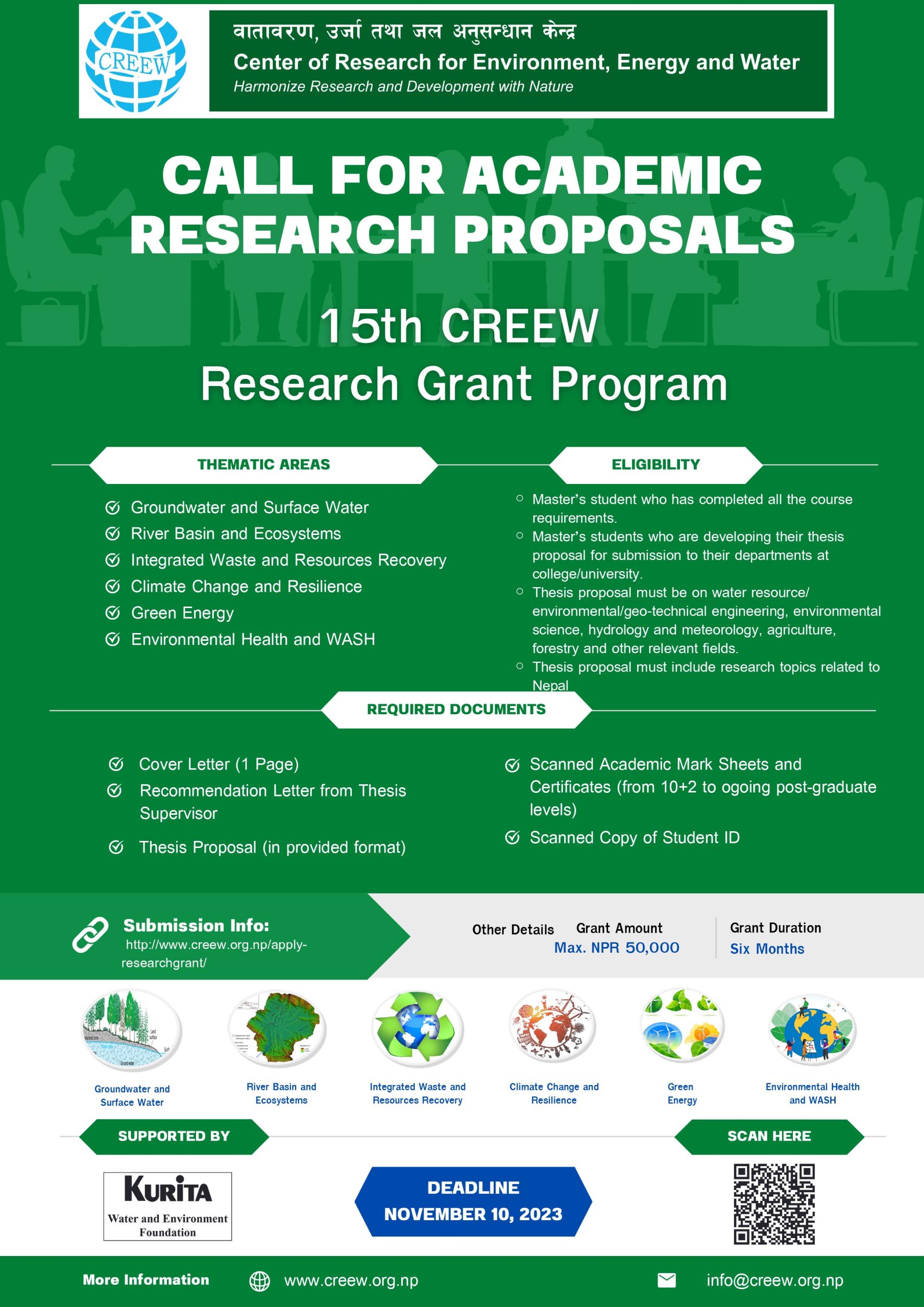
CREEW, a nonprofit and non-governmental organization dedicated to scientific research and development, has been actively involved in supporting Master’s level students since its establishment in 2008. Specifically, CREEW has initiated the Research Grant Program aimed at assisting students in the final year of their Master’s program who are working on thesis proposals within the realms of water, environment, natural resources, or other fields relevant to CREEW.
This program serves a dual purpose: not only does it offer financial grants to students, but it also immerses them in comprehensive research guidance and mentoring initiative. Grant recipients will collaborate closely with CREEW’s team of technical experts to refine their research proposals. Furthermore, they will participate in a minimum of three research-sharing meetings during the grant duration. These meetings provide an opportunity for grant recipients to share their progress, engage in discussions about their findings, and receive comments, suggestions and feedback to further enhance their research.
In this context, CREEW invites eligible students to apply for the grant, and the specific details for application are outlined as follows:
(A) Details of the Grant
1) Eligibility
- Master’s student who has completed all the course requirements.
- Master’s students who are developing their thesis proposal for submission to their departments at college/university.
- Thesis proposal must be on water resource/environmental/geo-technical engineering, environmental science, hydrology and meteorology, agriculture, forestry and other relevant fields.
- Thesis proposal must include research topics related to Nepal.
2) Priority thematic areas
Thesis proposal should preferably be on the following priority thematic areas, but other topics relevant to CREEW will be considered on case-by-case basis.
| Thematic areas | Sub-thematic areas |
| Groundwater and Surface Water | Quantity and quality, pollution and treatment, demand and supply, conjunctive water use, snow and glacier, groundwater-surface water interactions, managed aquifer recharge, hydrogeology, groundwater potential zoning, groundwater exploration, groundwater induced land subsidence, groundwater vulnerability and risk mapping, water resource assessment and management, sustainable hydropower development, policy and practice and, regulation |
| River Basin and Ecosystems | Integrated Water Resources Management (IWRM), hydrology, hydraulics, modeling, water-energy-food-nexus, watershed health, river basin management, river health and restoration, sustainable management of ecosystems and biodiversity, *ecosystem-based management, land and soil management, policy and practice
*Ecosystem and biodiversity mainly include of agriculture, pastures, lakes and rivers. |
| Integrated Waste and Resources Recovery | Waste types, generation and characteristics; 3R principle and practices, resource recovery from waste, waste treatment technologies, waste governance, waste management financing, waste and climate change, special waste management (healthcare, hazardous and e-waste management, fecal sludge management), waste to energy, waste burning, GHGs emissions, air pollution, circular economy, waste disposal and landfill engineering, life cycle assessment (LCA) |
| Climate Change and Resilience | Climate change impacts of various sectors, adaptation and mitigation; climate resilience, climate change modeling, climate finance, climate policy and practice, disaster risk management (DRM), disaster risk reduction (DRR) and resilience, Clean Development Mechanisms (CDMs), EbA and IKT for climate change adaption |
| Green Energy | Types of green energy: solar energy, wind energy, biomass, biogas, and hydroelectric energy; energy-mix, sustainable hydropower development, waste to energy, green economy, air pollution, carbon footprint |
| Environmental Health and WASH | Water quality and household water treatment, WASH in schools, WASH + emergencies, WASH + maternal and child health, WASH + nutrition, menstrual hygiene, behavioral change, health risks (chemical and microbial), emerging pollutants, cross-border and transboundary pollution, environmental footprint |
3) Grant amount and duration
The grant is capped at a maximum of NPR 50,000, with duration of six months.
4) Required documents
- Cover letter (1 Page)
- Recommendation letter from the thesis supervisor for the applicant with consent for applying the grant and, supervisor’s brief CV (1-2 pages). Supervisor should email the recommendation letter and brief CV to info@creew.org.np with subject line “CREEW Grant 2023/24 Recommendation and Consent Letter for Students Name”
- Thesis proposal
- Scanned academic mark sheets and their certificates only starting from 10+2, undergraduate and ongoing post-graduate levels
- Student ID
5) Application submission
- Application must be submitted online at https://www.creew.org.np/apply-research-grant/
- Please ensure that all the necessary documents listed above are submitted as a single PDF attachment file, accompanied by the cover letter. It’s essential to name the attached file in the format of <first name_family name-CREEW Grant 2023/24>.
6) Submission deadline
- All submissions must be made by November 10, 2023.
(B) Proposal format
7) Format of the proposal should be as follows
Cover letter (not more than 1 page)
Cover page followed by table of content
Main proposal (not more than 9 pages)
- Summary of the proposal (within 250 words)
- Introduction (Background; Statement of Problem; Research question; Objectives)
- Materials and methods (Description of study area; Methods of data collection; Data analysis; Methodological flow chart; Research matrix)
- Expected outputs and outcomes
- Research plan with schedule
- Budget required for the research (detail breakdown)
- References
Annexes
- Applicant’s academic mark sheet and character certificates (starting from 10+2 to recent year / semester)
- Student ID card

 G.P.O. Box: 25563